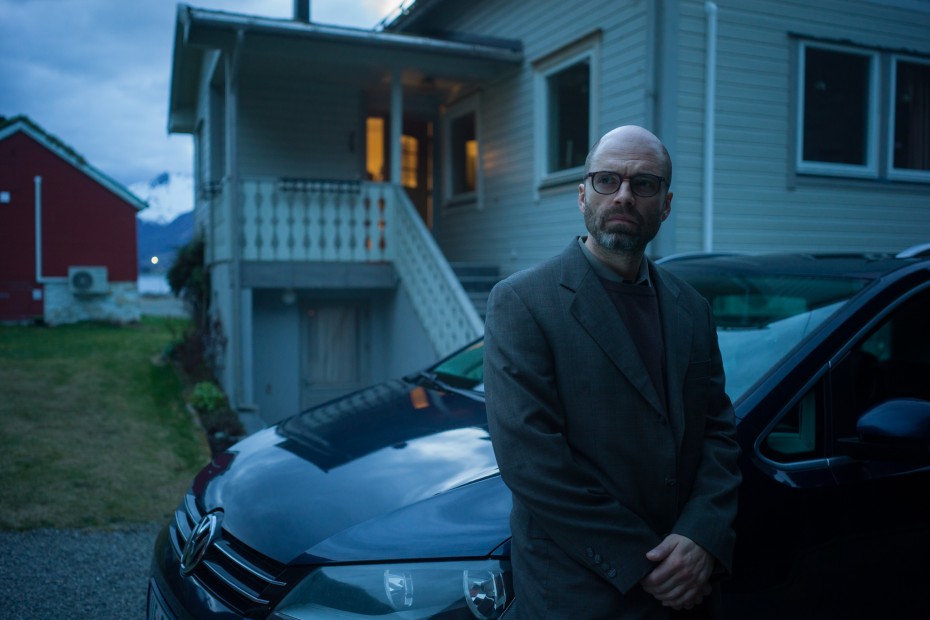
Cristian Mungiu‘s complex moral drama “Fjord,” starring Sebastian Stan and Renate Reinsve, has won the Palme d’Or for best film at the Cannes Film Festival, making the Romanian writer-director the tenth filmmaker to win the coveted award twice — 19 years after his first victory for “4 Months, 3 Weeks and 2 Days.” The film, about a Romanian family of Evangelical Christians mired in a child abuse case when they run afoul of the Norwegian social system, was among the more hotly debated titles in the Competition, with critics split on its merits and its sociopolitical allegiances — though evidently that very discussability united a jury headed by South Korean auteur Park Chan-wook.
Mungiu was typically self-effacing as he accepted the Palme. “All awards are contextual,” he said. “The fact that you gave me this award, it’s wonderful for us and we feel very happy, but we need to wait 10, 20 years to watch these films again, and maybe then we’ll understand which of them were really good, and managed to survive the test of time.” In the post-ceremony jury press conference, meanwhile, director Park wittily dodged the question of what motivated the Palme choice: “To be completely honest, I didn’t want to award the Palme d’Or to any of the films, because it’s an award that I myself have never gotten. But I had no other choice.”
This critic was among the admirers of the film (Mungiu’s first to be set and shot entirely outside his home country), describing it as a “superb new drama of systemic order and individual disarray [that] feels immediately of a piece with his searching, bristling oeuvre, despite its crisp new setting,” and praising Stan’s and Reinsve’s “measured, tightly clenched performances.” The win also represents a major coup for “Fjord’s” U.S. distributor Neon, which has now extended its Palme-winning streak to seven years running, beginning with eventual Oscar winner “Parasite” in 2019, and will certainly buoy their future awards hopes for Mungiu’s film.
The win wasn’t entirely expected: Many thought exiled Russian director Andrey Zvyagintsev, now based in France, would triumph for his icy anti-Putin neo-noir “Minotaur,” his first film in nine years, and a major comeback following a near-fatal battle with COVID a few years ago. In the end, Zvyagintsev had to be content with the Grand Prix, the fest’s second most prestigious award, but prospects look strong for the Mubi-backed title — a contemporary reworking of Claude Chabrol’s erotic thriller “The Unfaithful Wife,” set in Russia near the star of Putin’s war on Ukraine, but shot entirely in Latvia by political necessity.
In a heavily European-dominated slate of winners, the Best Director prize was shared by two oppositely styled historical visions: “Fatherland,” Polish director Pawel Pawlikowski’s meticulous evocation of post-war Germany, and “The Black Ball,” Spanish duo Javier Calvo and Javier Ambrossi’s sprawling, stylized, era-spanning ode to queer lives and loves lost to fascism, written through the prism of Federico Garcia Lorca’s poetry.
The tie provided the most amusing moment of the awards ceremony, with the confused shuffle of the three directors on stage prompting Pawlikowski to quip, “This is a piece of disastrous mise-en-scène!” But it also served up the two most stirring speeches of the night, with the Spanish filmmakers, known locally as Los Javis, overcome with emotion as they honored their queer antecedents: “The only way we can honor the suffering, the silence, the death of the LGBTQ people that came before us, is making sure that the next generation has the same freedom or more.”
Pawlikowski, meanwhile, spoke precisely and passionately about the need for a nuanced understanding of political cinema: “We live and breath politics, and cinema should reflect that, but not on terms dictated by politicians and activists: It takes courage to resist dictators and bullies, but it also takes courage to resist noise, algorithms, peer pressure. I think writers should be able to look beyond headlines, beyond information bubbles, beyond set narratives, and to talk about what they really feel, what they really see, what they really know, what they intuit. It’s important to keep that space free for art.”
Los Javis, meanwhile, weren’t the only duo honored on a night where collaborative artistry was especially celebrated. Both acting awards went to pairs of co-stars, with Frenchwoman Virginie Efira and Japanese star Tao Okamoto (the only non-European individual to take a prize from the jury, for a culture-melding French-Japanese production) sharing the Best Actress award for their exquisitely calibrated, conversational dual turn in Ryusuke Hamaguchi’s critical darling “All of a Sudden,” as a care home manager and experimental theater director who find a deep and unexpected bond through their respective lines of work.
Meanwhile, the two young stars of Belgian director Lukas Dhont’s First World War drama “Coward” — Valentin Campagne and newcomer Emmanuel Macchia — were stunned to jointly win Best Actor for their achingly sensitive portrayals of soldiers-turned-lovers on the Western Front. Their giddy, ebullient speech, as Campagne literally leaped into his co-star’s arms, was a joyful high in the ceremony.
German director Valeska Grisebach may have been the sole Jury Prize winner for her ambitiously experimental, documentary-influenced crime drama “The Dreamed Adventure,” but she didn’t see herself that way, calling her leading lady Yana Radeva onto stage as her most invaluable collaborator. Frenchman Emmanuel Marre, meanwhile, took Best Screenplay for another of the Competition’s most strikingly unconventional works, the fractured French Resistance drama “A Man of His Time.”
In something of a surprise, the Camera d’Or for best first feature across all sections of the festival went to Rwandan filmmaker Marie Clémentine Dusabejambo for her heartfelt debut “Ben’Imana” — a happy turnaround after the film was entirely blanked by the Un Certain Regard jury last night. It was a welcome triumph for African cinema on such a Eurocentric night.
Yet in a year where American films were conspicious by their general absence — the two U.S. Competition titles, James Gray’s “Paper Tiger” and Ira Sachs’ “The Man I Love,” both left empty-handed — the awards did encapsulate the major theme of this year’s festival: of film as a global, exploratory medium, with “Fjord,” “Minotaur,” “The Dreamed Adventure,” “Fatherland” and “All of a Sudden” all either addressing themes of displacement on screen, or made by filmmakers forging connections with new countries and national cinemas.